
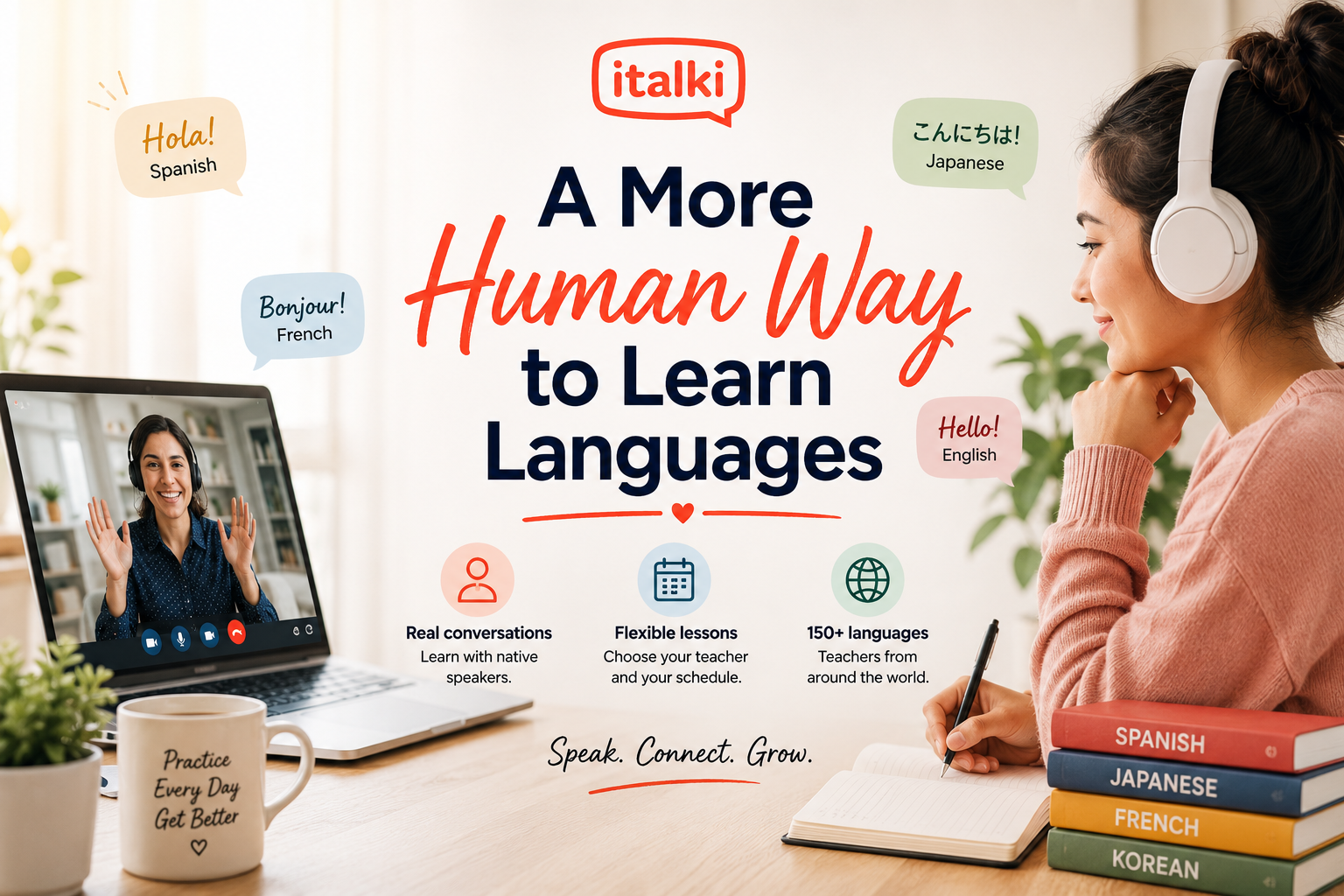
I Knew the Words. I Just Couldn’t Speak.
It was a simple question.
“Where are you from?”

I knew the answer.
I had answered it hundreds of times in my own language.
But this time, someone was asking me in English.
And suddenly, the sentence that should have taken five seconds took almost twenty.
“I am from…”

Pause.

“India.”
Another pause.
The person smiled and waited.
I knew the words. I knew the grammar. I had studied English for years.
So why was speaking so difficult?

That was the moment I understood something many language learners eventually discover:
Knowing a language and feeling comfortable using it are not the same thing.

The Problem With Learning From a Screen
For years, learning a language often meant sitting with a textbook, memorising vocabulary or completing exercises.
Today, the options are much bigger.
There are apps, videos, podcasts, online courses, quizzes and AI-powered learning tools.
They’re useful.
But there is one thing they can’t completely replace:
a real conversation with another person.
You can know that the past tense of a verb is went.
But knowing went doesn’t automatically make you comfortable saying:
“I went to the market yesterday.”
You have to use it.
You have to make mistakes.
You have to hear someone respond.
And eventually, your brain starts becoming comfortable with the language instead of simply recognising it.
That’s Where the Search for a Teacher Begins
Imagine you’re learning Spanish because you’re planning a trip.
You don’t necessarily want to spend six months studying grammar before saying your first sentence.
You want to order food.
Ask for directions.
Talk to people.
Understand what someone is saying.
Or perhaps you’re learning Japanese because you love the culture, preparing for a move, studying for work, or simply challenging yourself.
Your reason for learning matters.
And the teacher you choose matters too.
This is where italki takes a different approach.
Instead of putting every learner into the same course, italki allows learners to browse teachers and choose someone based on their language, interests, teaching style, specialisation and even accent. The platform currently offers teachers across more than 150 languages.
That choice can make online learning feel much more personal.
Your Teacher Doesn’t Have to Be “The Perfect Teacher”
There is no universal perfect teacher.
The teacher who is great for someone preparing for an English interview may not be the right person for someone learning English simply because they want to speak more confidently.
A beginner may want patience and repetition.
An advanced learner might want challenging conversations.
Someone learning French for travel may want everyday expressions.
Someone preparing for an exam may want structured lessons.
That’s why having options matters.
On italki, learners can explore different teacher profiles and decide who fits their goals rather than simply being assigned a course.
And because teachers set their own prices, learners can compare options before booking. Lessons are paid for individually rather than requiring a fixed subscription.
Then Comes the First Lesson
This is usually the nervous part.
You open the lesson.
You see another person on the screen.
And for a moment, you wonder:
“What am I supposed to say?”
Then the teacher asks a question.
You answer.
Maybe badly.
Maybe slowly.
Maybe with three grammar mistakes in one sentence.
And that’s okay.
Because the purpose isn’t to prove that you already speak the language.
That’s why you’re there.
The current italki offering supports lessons of different lengths, including 30, 45, 60 and 90 minutes, which can make it easier to fit practice around work, college, travel or everyday life.
Thirty Minutes Can Feel Surprisingly Long
When you’re speaking a language you’re still learning, thirty minutes can feel very different from thirty minutes in your native language.
You have to think.
Listen.
Translate sometimes.
Find the right word.
Correct yourself.
Try again.
But that’s also where something important happens.
The words begin moving from your memory into your conversations.
You stop only recognising a phrase.
You start using it.
That difference is easy to underestimate.
You Don’t Have to Learn Only One Way
One of the more interesting things about modern language learning is that a lesson doesn’t have to be the entire learning experience.
You can have a one-to-one lesson and then continue practising outside it.
italki also has a free Community where learners can ask questions, share content, practise languages and interact with other learners. Its current learning ecosystem also includes podcasts, quizzes and other resources.
That means your learning doesn’t necessarily stop when the lesson ends.
You might hear a new phrase from your teacher.
Later, you hear it again in a podcast.
Then you see someone use it in a community post.
Eventually, it doesn’t feel new anymore.
That’s how familiarity grows.
And Then There Are Group Classes
Not everyone wants a one-to-one lesson every time.
Sometimes you want to hear other learners speak.
You want to listen before answering.
You want to realise that you’re not the only person who forgets vocabulary halfway through a sentence.
italki also offers group classes alongside its one-to-one lessons.
For some learners, that social element can make practice feel less like studying and more like participating.
Of course, group learning isn’t automatically better than individual learning.
It depends on your goal.
If you need highly focused feedback, one-to-one time can be valuable.
If you enjoy learning with others and hearing different responses, a group can offer something different.
The useful part is having the choice.
The Real Test Happens Outside the Lesson
A few weeks later, you might find yourself in a completely ordinary situation.
You’re travelling.
Someone asks you a question.
And this time, you don’t freeze.
You answer.
Not perfectly.
Maybe you still make a mistake.
But you answer without spending twenty seconds building the sentence in your head.
That’s progress.
Not a certificate.
Not a streak.
Not a number on a screen.
Just a real conversation that feels a little easier than it did before.
Language Learning in 2026 Is Becoming More Personal
The way people learn languages is changing.
Technology can help with vocabulary, listening practice, exercises and quick feedback.
But the human side of learning still matters.
A teacher can notice when you’re hesitating.
They can change the conversation.
They can explain why a phrase sounds natural.
They can encourage you when you’re frustrated.
And sometimes, they can simply give you another chance to say the sentence you couldn’t say five minutes ago.
That combination of technology and human interaction is becoming increasingly important in online education.
And it explains why platforms like italki continue to focus on connecting learners with real teachers rather than turning language learning into a completely automated experience.
So, Is italki Worth Trying?
That depends on what you’re looking for.
If you want a completely self-guided experience, there are plenty of tools available.
But if your biggest problem is “I understand the language, but I don’t feel confident speaking it,” working with a teacher can be a very different experience.
You can choose a teacher.
Choose a lesson length.
Choose when you want to learn.
Choose how frequently you want to practise.
And, importantly, you can change your approach if something isn’t working.
There is no requirement for every learner to follow the same path.
Maybe the Goal Was Never to Speak Perfectly
Go back to that first question.
“Where are you from?”
The next time someone asks it, perhaps the answer comes naturally.
“I’m from India.”
No long pause.
No panic.
No searching through your memory for the correct grammar.
Just an answer.
That’s what language learning is ultimately about.
Not knowing every word.
Not speaking without mistakes.
Not sounding exactly like someone who grew up speaking the language.
It’s about reaching the point where the language stops feeling like a subject you’re studying and starts feeling like something you can actually use.
And sometimes, getting there begins with something very simple:
finding someone to talk to.
If you’re ready to practise with a teacher, you can explore language teachers and lesson options on italki
Leave a Reply